
Regional expertise

Russia and the wider Eurasian region.

Investigative research, due diligence and regional investigative reports, carried out in the original languages and records of the former Soviet space and its neighbours.

Mountain ridges in evening haze
Why it matters

Research that English-language sources cannot do alone.

Most of what matters about a company or a person in this region is recorded in Russian or a national language, in registers and court systems that work differently from their Western counterparts. Since 2022, access to many of those records has narrowed, and laws on foreign funding have made some local work more sensitive.

Our regional practice is built for these conditions. We work from the original records, read them in the original languages, understand how local institutions operate in practice, and are candid about what cannot be established lawfully or safely.

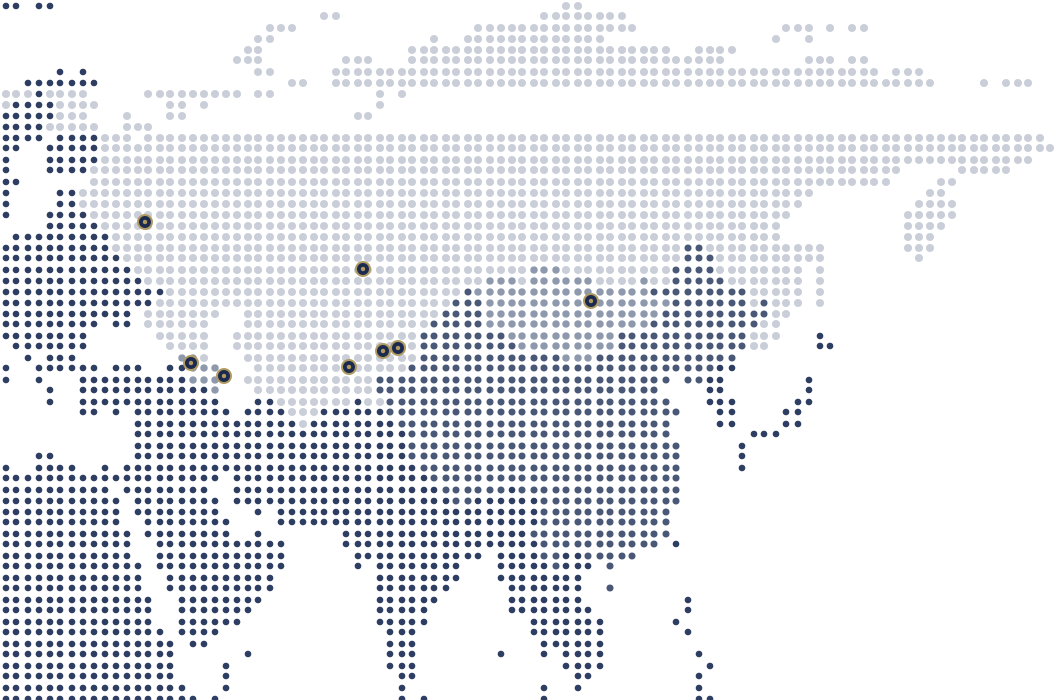
Map of Eurasia highlighting Russia and Central Asia, with the South Caucasus, Mongolia and China
Core coverageRegular coverageConnected workKey cities
The Russian Federation

Russia

Research on Russian companies, people and events has become harder since 2022, and more necessary. Registers have narrowed, access from abroad is unreliable and much of what matters is published only in Russian. We work from the records that remain, read them in the original and state plainly what they can support.

Working conditions

Access to Russian official sources from abroad is unreliable, and some companies may lawfully restrict what they disclose. Engaging Russian data providers can raise sanctions questions, and people assisting research inside the country may face legal risk. We plan for each of these before work begins.

Sources we work from
  • The state register of legal entities and its history of changes
  • Commercial (arbitrazh) court files, bankruptcy notices and enforcement records
  • Public procurement records and corporate disclosure filings
  • Federal and regional media in Russian, and archived web material
Questions clients bring us
  • Who owns and controls a company, and how that has changed since 2022
  • Whether a counterparty is owned or controlled by sanctioned persons
  • The litigation and insolvency history of a business or its owners
  • Where assets connected to a person or company are held, at home and abroad
Kazakhstan, Uzbekistan, Kyrgyzstan, Tajikistan and Turkmenistan

Central Asia

The five Central Asian states differ widely in openness, legal systems and the quality of their records. Some publish a good deal of company and court information online, and reforms in recent years have opened more. Elsewhere, public records are thinner and careful local knowledge carries more weight. Research needs Russian and the national languages, identifiers rather than names, and attention to the regions as well as the capitals.

Working conditions

Record quality is uneven, names are spelled differently across Russian, national languages and Latin scripts, and several jurisdictions have expanded laws on foreign funding in recent years. We anchor findings to identifiers, search in the original script first and assess the risk to anyone who helps us locally before work begins.

Sources we work from
  • National company registers and open-data portals, searched by official identifiers where available
  • Court decisions and public procurement information
  • The public register and English-language judgments of the Astana International Financial Centre
  • Local-language media in Kazakh, Uzbek, Kyrgyz, Tajik, Turkmen and Russian
  • Records in other jurisdictions where regional businesses hold assets
Questions clients bring us
  • Who stands behind a privatised asset or a new local partner
  • Links between counterparties and politically exposed persons
  • Background on partners in extractive, energy, logistics and infrastructure projects
  • Trade and re-export patterns involving regional companies
  • Dispute and enforcement history before a transaction
Georgia, Armenia and Azerbaijan

South Caucasus

The South Caucasus sits on trade and energy routes between Europe, Russia, Iran and Central Asia. The three countries differ in how much their registers disclose, and each has its own language and script alongside Russian.

Working conditions

Reading the record properly takes three national languages and scripts, as well as Russian. We work with documents in the original and record every spelling variant we find.

Sources we work from
  • Company and property registers, where publicly accessible
  • Court decisions and public procurement records
  • Local media in Georgian, Armenian, Azerbaijani and Russian
  • Corporate and transport records linked to regional trade routes
Questions clients bring us
  • Ownership of logistics, transit and energy businesses
  • Trade flows to and from Russia through the region
  • Background on partners and investors in regional projects
  • The reputational history of companies and their principals
China, Mongolia and links to Central Eurasia

Wider Asia

Much of the investment in Central Asia originates in China, and resource projects extend into Mongolia. Following a structure from a local project company to its parent group means working across Chinese, Russian and national records.

Working conditions

Access to Chinese data from abroad can be restricted, and rules on data security and transfer have tightened. We use published sources only and never ask anyone inside China to take risks on our behalf.

Sources we work from
  • Chinese company registration data and unified social credit codes
  • Exchange filings of listed parent groups in Shanghai, Shenzhen and Hong Kong
  • Host-country registers, courts and procurement records
  • Chinese-language and local-language media
Questions clients bring us
  • Which group stands behind a project company
  • Whether a counterparty is state-owned or state-linked
  • The real status of announced investment projects
  • Background on Asian partners in regional transactions
Service VII

Regional investigative reports.

In-depth investigative reports on companies, people, sectors and events in Russia, Central Asia, the South Caucasus and the wider Eurasian region, researched in the original languages to the standards of investigative journalism. Reports can be written for a media organisation to publish under its own name, or for an institution, investor or law firm that needs a full and reliable account.

You receive
  • A long-form report written to publication standard, with every factual claim sourced
  • A source annex and claim-by-claim verification log for editors and lawyers
  • Research in Russian and the national languages, with original-language documents preserved
  • A briefing for editors, counsel or decision-makers on findings and open questions
Typical uses
  • A media investigation into a cross-border business network
  • An NGO or institutional report on governance in a sector or region
  • An investor's in-depth account of a regional group before a major decision
  • Background research for a documentary or a long-form series
How we work in the region

Language, law and duty of care.

The standards that govern all our work apply here with particular force. Six commitments shape every regional engagement.

Original languages

Searches start in the original script. Documents are read in the original and translated for the report, with every spelling variant of every name recorded.

Lawful sources only

We use published records and lawful channels. We do not use leaked databases of unlawful origin, pretexting or inducements, however common they may be locally.

Sanctions awareness

Data providers, intermediaries and payment routes are checked against the sanctions regimes that apply to us and to our clients before they are used.

Duty of care

No one is asked to take a risk they have not understood. Risks to local researchers and sources are assessed before tasking and again before any report is published.

Graded findings

Where records are thin, conclusions rest on fewer sources. Each finding carries a stated level of confidence so readers know what it can bear.

Candour about limits

Some questions cannot be answered lawfully or safely. When that is the case, we say so at the outset rather than in the final report.

Research languages
  • Russian
  • Kazakh
  • Uzbek
  • Kyrgyz
  • Tajik
  • Turkmen
  • Georgian
  • Armenian
  • Azerbaijani
  • Chinese
  • English
Typical engagements

The kind of work the region brings us.

These examples illustrate typical regional engagements. They are composites written for this page and do not describe real clients or matters.

  • Central AsiaMedia

    A broadcaster preparing a documentary needs the ownership of a mining group verified before broadcast, including a holding company registered in the Astana International Financial Centre.

  • Central AsiaInvestors

    A fund considering a stake in a privatised manufacturer in Uzbekistan needs to know how the asset left state hands and who controls the buyer today.

  • RussiaLegal

    A law firm acting in a commercial dispute needs documented evidence of assets connected to a Russian counterparty, in Russia and abroad, for use by counsel.

  • South CaucasusNGOs

    An NGO commissions a publishable report on how restricted goods move through regional trade routes, with every claim sourced and graded.

  • Wider AsiaInstitutions

    A development lender needs background on a Chinese contractor's local project company before financing a power plant in Central Asia.

  • Central AsiaMedia

    A newsroom needs an investigation into public procurement in a regional city fact-checked, claim by claim, before publication.

Enquiries

Discuss a regional enquiry in confidence.

Tell us what you need to know. A first conversation is confidential and without obligation.